
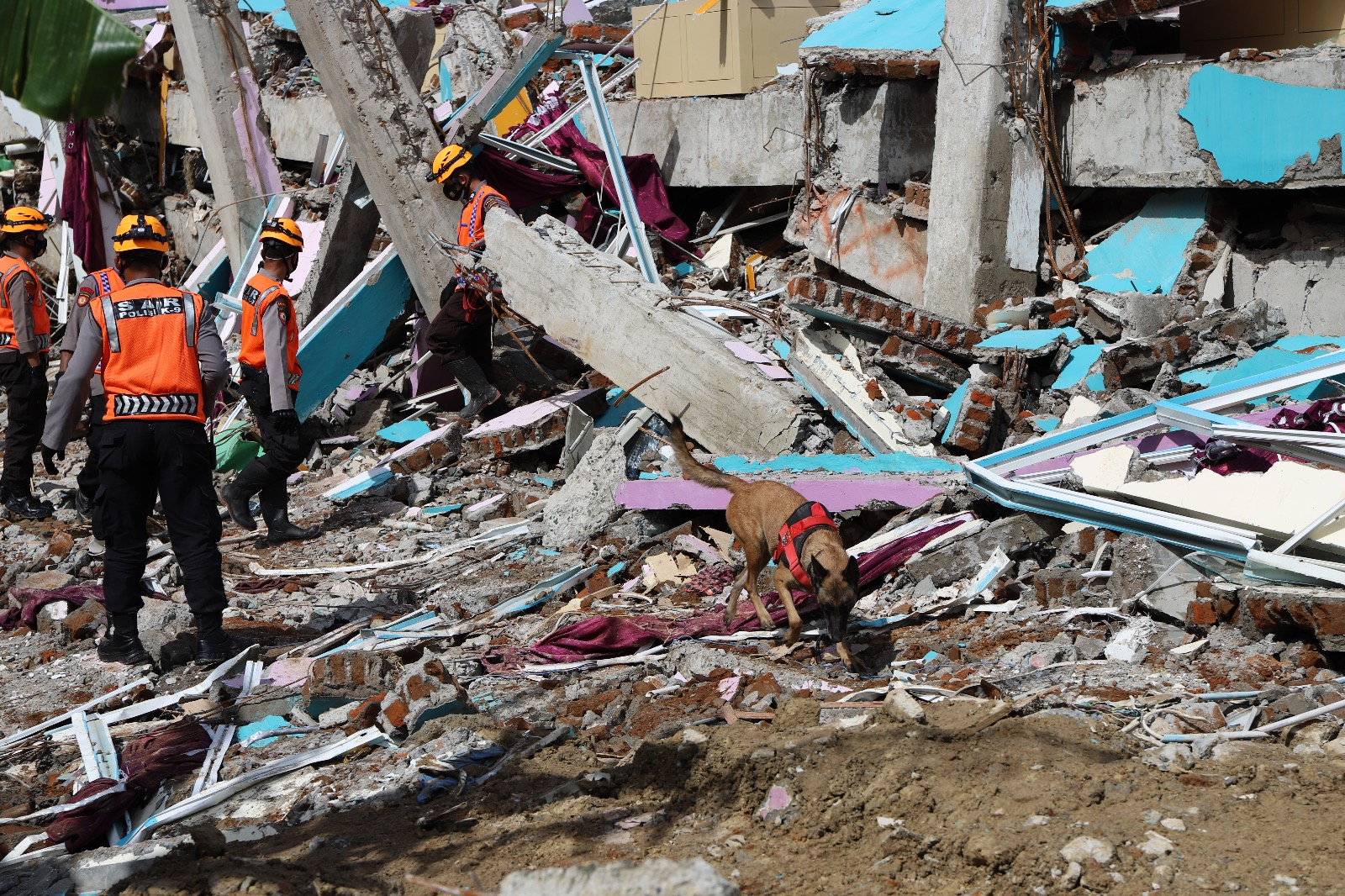
The Disaster Risk Financing and Insurance (DRFI) Strategy is a combination of financial instruments to obtain an adequate, timely, effective, sustainable, and transparent disaster risk funding scheme.
Brief History: This strategy was developed by the Fiscal Policy Agency (BKF) and officially launched by the Vice President of the Republic of Indonesia in October 2018 in Bali during the IMF/World Bank Annual Meetings. The PARB was created as a solution to Indonesia’s challenges as the 12th-highest disaster-risk country in the world.
Indonesia faces extreme geological and hydrometeorological hazards due to its geographic location. This high ranking reflects the vulnerability of a large population living in earthquake-, tsunami-, and flood-prone areas across the country.
Complete reliance on the state budget creates a funding gap when a major disaster occurs, potentially disrupting economic stability and slowing recovery.
100% of disaster risks directly burden the budget.
Layered shields protect the budget from volatility.
Unfunded liabilities.
Indonesia menghadapi ancaman geologis dan hidrometeorologi ekstrem karena lokasi geografisnya. Peringkat tinggi ini mencerminkan kerentanan populasi besar yang tinggal di wilayah rawan gempa, tsunami, serta banjir di seluruh pelosok negeri.
Ketergantungan penuh pada APBN menciptakan celah pendanaan (funding gap) saat terjadi bencana besar, yang berpotensi mengganggu stabilitas ekonomi dan memperlambat pemulihan.
Situated at the intersection of tectonic plates and volcanic belts, Indonesia faces significant geological and hydrometeorological risks. This geographic location places millions of residents at constant risk from earthquakes, tsunamis, and flash floods. The high national risk rating is not simply a number; it reflects the vulnerability of populations spread across disaster-prone areas. Collective preparedness is needed to mitigate impacts across the country, protecting public safety and future environmental stability.
Complete reliance on the state budget creates a funding gap when a major disaster occurs, potentially disrupting economic stability and slowing recovery.
Realisasi anggaran melonjak seratus persen dari plafon awal akibat gempa besar Yogyakarta yang menuntut percepatan pendanaan darurat.
Rentetan bencana katastropik memicu lonjakan realisasi hingga empat belas triliun rupiah yang menegaskan perlunya reformasi strategi.
A major disaster exceeds planned reserve funds.
The massive tsunami disaster forced budget realization to be fully absorbed from the initial ceiling for emergency funding and energy subsidies.
Budget realization jumped one hundred percent from the initial ceiling due to the major Yogyakarta earthquake which required accelerated emergency funding.
A series of catastrophic disasters triggered a surge in realization of up to fourteen trillion rupiah, which emphasized the need for strategic reform.
Ketergantungan penuh pada APBN menciptakan celah pendanaan (funding gap) saat terjadi bencana besar, yang berpotensi mengganggu stabilitas ekonomi dan memperlambat pemulihan.
The government no longer bears all risks alone. We use a tiered approach:
retaining small risks (retention) and transferring large risks (transfer) to insurance.
This strategy combines various financing schemes for maximum efficiency. Based on historical data, the government has limited budget to cover all economic losses from major disasters.
Disaster categories Rare vs Frequent.
Large vs. Small economic/physical losses.
Optimal for frequent disasters/small losses (low-scale earthquakes). Source: APBN/APBD, Pooling Fund, & Contingency Loans.
Mandatory for major disasters (Tsunami/Large Earthquake) to facilitate access to funds from external sources.
BMN Insurance, Reinsurance, Capital Market
Standby Loan, PFB
APBN (Reserve Fund), APBD
Strategi Risk Layering changing the paradigm of disaster management from reactive to proactive to maintain the continuity of the APBN.
Transferring risk to global markets to prevent sudden debt spikes due to major disasters.
Providing fast access to funds through the Disaster Pooling Fund without lengthy budget bureaucracy.
Small-scale disasters are handled directly by the APBN/APBD so that core development continues.
All disaster risks directly burden the state budget (APBN/D)
Risk is partially transferred to the global insurance market
Risk Layering strategy ensures sustainable development
Transferring risk to the insurance market to prevent sudden debt spikes caused by large-scale disasters.
Small-scale disasters are retained and managed directly through regular state and local budget expenditure instruments.
BMN Insurance, Parametric Insurance, International Reinsurance.
Joint Fund (PFB) and Contingent Loans.
APBN (Reserve Fund) and Regional APBD.
Major disasters exceed reserve funds so
requires a comprehensive risk funding strategy.
Realisasi anggaran melonjak seratus persen dari plafon awal akibat gempa besar Yogyakarta yang menuntut percepatan pendanaan darurat serta pemulihan infrastruktur.
The massive absorption of reserve fund allocations to support the recovery of the West Sumatra region demonstrates the urgency of quickly providing fiscal liquidity.
A series of catastrophic disasters triggered a surge in realization of up to fourteen trillion rupiah, which emphasized the need for reform of the national disaster risk funding strategy.
Complete reliance on the state budget creates a funding gap during major disasters,
which has the potential to disrupt economic stability and slow recovery.
All risks are borne by the APBN/D
Some of the risk is transferred to the insurance market
Click on the shield layer to see how the PARB instrument drastically reduces the residual risk burden of the APBN.
The Disaster Pooling Fund (PFB) is the primary instrument of the PARB Strategy. The PFB is a scheme for collecting, accumulating, and disbursing funds specifically for disasters by a fund management institution. The PFB’s establishment aims to protect the state budget from disaster-related pressures through proactive efforts during non-disaster periods, through investments in accumulated funds and risk transfer through insurance.
To accelerate the protection of BMN/BMD and strengthen fiscal resilience against disasters
The first risk transfer instrument launched since the 2019 pilot at the Ministry of Finance. Focusing on Compensation Insurance, where claims are paid according to the actual value of damage through a Loss Adjuster assessment.
Designed for the rapid reconstruction of vital infrastructure (bridges, hospitals, schools) during emergency response. Claim payments occur immediately after triggering parameters are met.
Trigger Mechanism: “Claims are paid out within days if the parameters (Example: Earthquake MMI Scale) are met. However, there is no claim if the parameters are not met even if there is physical damage.“
Status: Regulations are being drafted “Other Risk Transfer Mechanisms” to differentiate it from conventional schemes.
Chosen because the earthquake parameters are the clearest and most accurately measured by independent international/national institutions.
Data accuracy from National / International Independent Institutions.
Disaster risks for high-frequency events with relatively low impacts are mitigated through budget allocations in the national and regional budgets. These budget allocations are realized in the form of disaster management programs by each agency/regional government.
A physical asset protection scheme for state-owned property. Operates on the indemnity principle, providing compensation based on the actual valuation of damage.
Total Value of Insured Assets
Includes: MoF (Kemenkeu), State Secretariat (Kemensetneg), Health (Kemenkes), and Religious Affairs (Kemenag).
Parameter-based (index) protection scheme. Claims are automatically paid out when disaster parameters are reached (e.g., a 7.0 SR earthquake), without waiting for a damage survey.
Key Advantage: Speed. Funds are disbursed within days for emergency response.
The Disaster Pooling Fund (PFB) is the primary instrument of the PARB Strategy. The PFB is a scheme for collecting, accumulating, and disbursing funds specifically for disasters by a fund management institution. The PFB’s establishment aims to protect the state budget from disaster-related pressures through proactive efforts during non-disaster periods, through investments in accumulated funds and risk transfer through insurance.
To accelerate the protection of BMN/BMD and strengthen fiscal resilience against disasters
The first risk transfer instrument launched since the 2019 pilot at the Ministry of Finance. Focusing on Compensation Insurance, where claims are paid according to the actual value of damage through a Loss Adjuster assessment.
Designed for the rapid reconstruction of vital infrastructure (bridges, hospitals, schools) during emergency response. Claim payments occur immediately after triggering parameters are met.
Trigger Mechanism: “Claims are paid out within days if the parameters (Example: Earthquake MMI Scale) are met. However, there is no claim if the parameters are not met even if there is physical damage.“
Status: Regulations are being drafted “Other Risk Transfer Mechanisms” to differentiate it from conventional schemes.
Chosen because the earthquake parameters are the clearest and most accurately measured by independent international/national institutions.
Data accuracy from National / International Independent Institutions.
Menyediakan likuiditas cepat melalui dana bersama.